
If you want to learn RMs so you can properly advise your clients, this is your lucky day. I’ve teamed up with Todd Ballenger, founder, and CEO of Borrow Smart University. I’ve known Todd for 20+ years, and he’s one of the most credible experts in the mortgage space. He also has a lot of educational content AND software to run numbers on various mortgage concepts, including RMs.
RMs are one of the most misunderstood products being sold to seniors. They are also one of the more abused tools in the industry (sales are being made in an inappropriate manner to seniors who don’t know any better). There is a place for RMs, but large commissions are driving far too many unsuitable sales. ALL advisors should FULLY understand RMs so suitable advice can be given to clients.
Education on RMs
This newsletter offers two pieces of education on RMs.
1) A FREE online interactive book (it takes about 60 minutes to read).
2) A two-part webinar series on August 13 and 20 at 4 p.m. EST.
To sign up to read the book AND/OR for the webinar series, click on the following (the webinar series will be recorded):
https://advisorshare.com/reverse-mortgages
Two Very Different Opinions on RMs
Certain advisors think RMs are a magic bullet—a way to solve income gaps, pay off debt, and fund long-term care all at once. Other advisors (the majority) warn their clients to stay away from them altogether. Neither opinion is wholly accurate nor inaccurate.
Lack of Education—the reason most advisors don’t feel good about RMs is that they don’t truly understand how they work and when they work. Lack of education is also a reason that RM salespeople blindly tell clients they are a magic bullet.
The “cure-all” pitch is the problem
Too many RM conversations start and end with what the product can do, not whether it should be used in this client’s specific situation. Home equity is often a client’s largest asset outside their portfolio — turning it into a source of retirement income is a legitimate strategy. But “legitimate strategy” and “right for this client, right now, in this amount, for this reason” are two different conversations. A salesperson focused on closing doesn’t always have that second conversation. You do.
Two different fact patterns (one that makes sense and one that does not):
Client A—65-year-old with a $1,000,000 home with no debt. He has $2 million in investments, good SS income, $90,000 of annual expenses, and he’s in good health.
RM salesperson says: Everyone should get a RM because the line of credit grows, and it’s great to have in case you need it someday.
Client A is not a good candidate for an RM. He has substantial liquidity, can self-insure for future financial events, and has decades of excess assets.
He essentially paid $25,000-$35,000 in closing costs for a maybe someday RM (and the lost negative amortization on those costs as the “house paid for them.”)
Client B—78-year-old widow who has lived in the same house for 45 years. She raised her kids there, and if she leaves that house to downsize into a condo, she will be absolutely devastated. She understands that the RM will reduce the size of the estate that will pass to her heirs, but she believes she will become so depressed that her health will be negatively affected if she moves out of the home.
Client B is the classic client who can benefit from an RM. The client is aware that a negative amortizing RM will reduce the amount of wealth passed to the heirs. She, and most likely her heirs, are ok with RM because of the higher quality of life for mom if she stays in the house.
Those are simple fact patterns. You’ll run into a hundred more — different equity levels, health situations, family dynamics, varying timelines of two spouses years apart, charitable giving, grandparents funding college, advanced inheritance strategies — and the honest answer is that an RM works less often than salespeople suggest, and works well more often than the skeptics assume.
The only way to tell the difference is to run the numbers for each client so you can determine for yourself if it’s a good idea for your clients.
Two-Part Webinar Educational Series on Reverse Mortgages
This two-part series was built to give you a working understanding of Home Equity Conversion Mortgages (HECMs) — not a sales pitch, not a scare campaign:
–August 13th at 4 p.m. — Fundamentals: how HECMs actually work, the cost structure, and where the suitability lines are.
–August 20th at 4 p.m. — Case Studies: real fact patterns like the two above, worked through in detail, so you can see how the math changes the answer.
Free Access to Reverse Mortgage Calculator
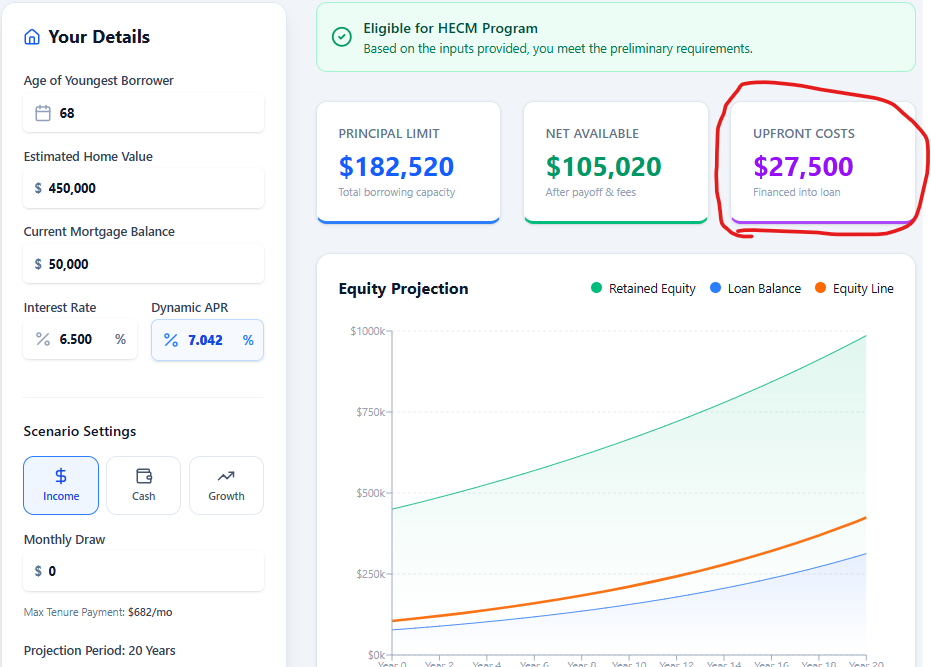
Those who sign up for the book and/or webinar series will also get access to a really cool RM calculator/simulator. With the Simulator, you plug in a client’s actual numbers — age, home value, existing liens, target cash draw — and it shows you exactly what they’re getting and what it costs: total principal available, cash available in year one, monthly income for life, and a year-by-year net worth comparison with and without the loan.